


EAEU Court: Russia Has No Right to Levy Additional Duties on Goods Cleared in Kazakhstan at Common Customs Tariff Rates
On 20 November, the Grand Panel of the EAEU Court concluded that the customs authority of one Union country cannot charge increased duties on foreign goods already lawfully released in another EAEU country. The reason was the practice of Russian customs, in effect since the end of 2025.
The court issued its advisory opinion following an application by the National Chamber of Entrepreneurs of Kazakhstan "Atameken". It clarifies how goods must move freely within the Union.
Russian customs referred to Russian Government Resolution of 7 December 2022. This document introduced increased rates as a retaliatory measure against a number of unfriendly countries. On this basis, customs levied additional duties on third-country products imported from Kazakhstan. Such goods had already been cleared in Kazakhstan at the EAEU Common Customs Tariff rates and had obtained the status of Union goods. For exporters, this resulted in extra costs, higher logistics expenses and disputes in Russian courts.
The court stated: after release for domestic consumption with payment of duties at the CCT rates, the obligation to pay import duties ceases. A requirement to pay the difference up to the increased national rate contradicts the Customs Code of the Union. The right of countries to introduce retaliatory duties against third countries remains, but such measures are not applied in mutual trade within the EAEU. The opinion is advisory in nature.
What does this mean for shippers?
A third-country product cleared in Kazakhstan at CCT rates is considered a Union good. The decision on its release is valid throughout the entire EAEU territory, and the customs authority of another country cannot unilaterally revise it. The exception is post-clearance control if the EAEU's own rates were understated at the initial declaration.
The court also confirmed that a declarant has the right to release goods in any Union country, even if it plans to send them immediately to another EAEU state. Such movement does not violate customs rules.
The opinion is not binding, but the positions of the Grand Panel shape uniform practice. For companies, this is a weighty argument in current and future disputes with customs.
How may this affect logistics?
- Goods released in Kazakhstan at CCT rates retain the status of Union goods when moving across the EAEU
- Companies that were charged additional duties on import from Kazakhstan now have a weighty argument in disputes with customs
- Customs clearance in one EAEU country with onward shipment to another is not considered a violation of customs rules
- The correctness of CCT rates at declaration remains key: if they are understated, post-clearance control is possible
What does ZHEBE Logistics recommend?
Make sure that goods are declared at the correct CCT rates upon release in Kazakhstan: it is precisely the understatement of EAEU rates that allows customs to revise the release through post-clearance control. Keep the full set of documents on release for domestic consumption if the cargo will travel further across Union countries.
If additional duties have already been charged to you, discuss with lawyers a reference to the EAEU Court's opinion. ZHEBE Logistics has been handling customs clearance and transportation on the China — Kazakhstan route since 2014 and can help prepare documents for your shipment.
Author: ZHEBE Logistics editorial team
Related services
Planning a shipment from China via Kazakhstan?
Calculate shippingMore news
Kazakhstan and Russia Provisionally Agree on Exchange of Road Transport Permit Forms for 2027
Kazakhstan and Russia have provisionally agreed on an exchange of permit forms for international road transport for 2027. An additional exchange for 2026 has also been agreed, taking into account carriers' current needs.
Read
EEC Council allows AEOs to split and repack consignments in temporary storage without customs permission
The EEC Council has expanded the list of operations that authorized economic operators (AEOs) may carry out with goods without customs permission. In temporary storage, these are the splitting and repacking of consignments; in a customs warehouse, simple assembly and maintenance.
Read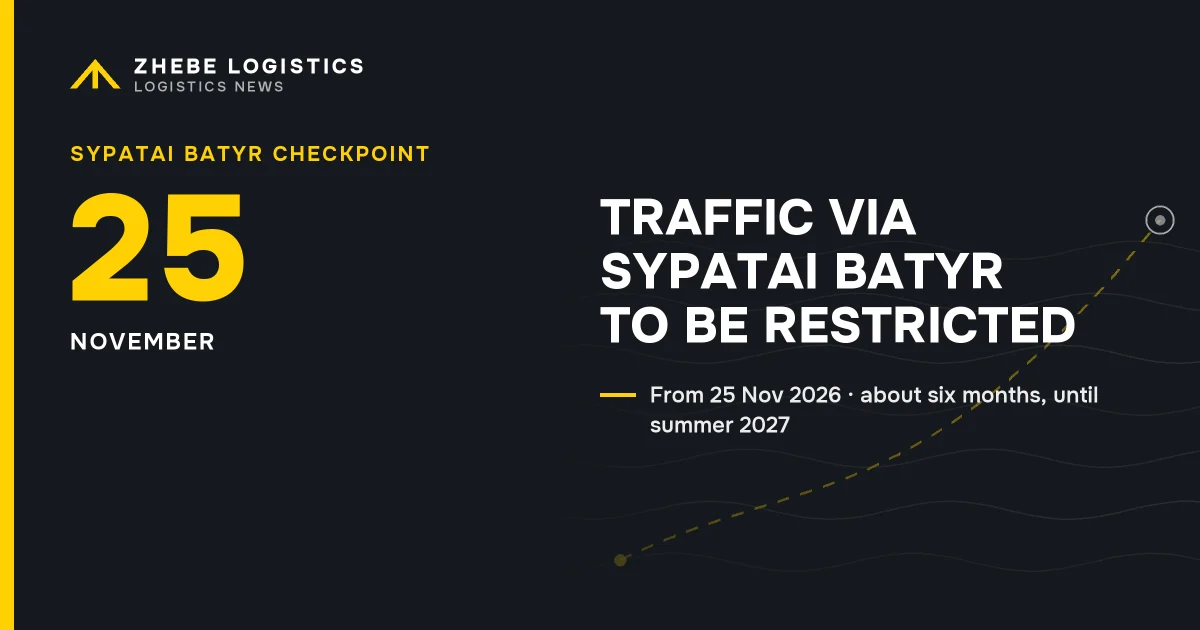
Sypatai Batyr checkpoint on the border with Kyrgyzstan to be closed to all types of transport for about six months
From 25 November 2026, construction work begins at the Sypatai Batyr road checkpoint, and traffic of all types of transport through it will be temporarily restricted for about six months. For trucks entering Kyrgyzstan from Kazakhstan through this crossing, the restriction has been in effect since 23 November.
Read